
People and traffic
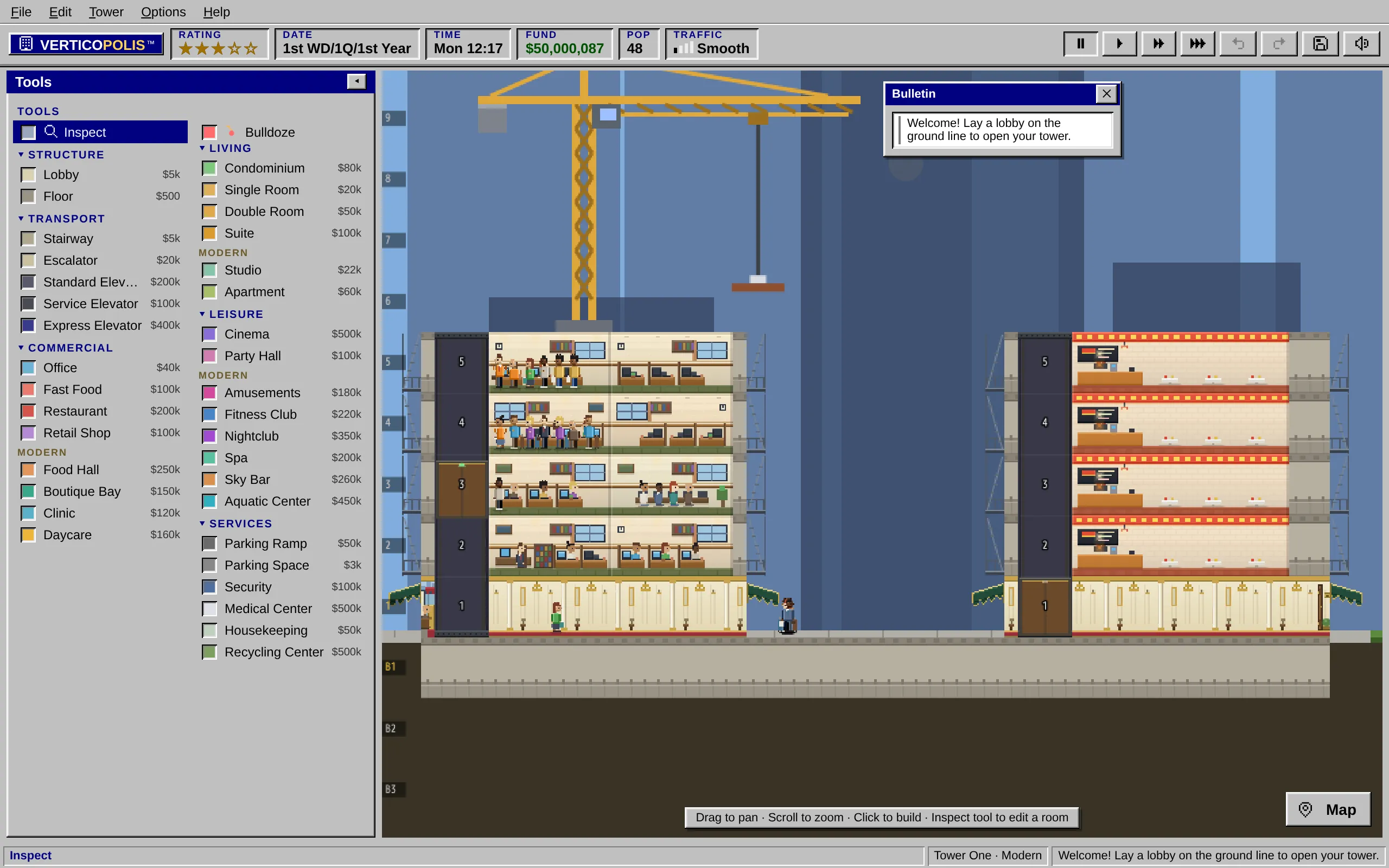
Every little figure you see walking the floors and riding the elevators is a real person in the game, on a real trip. When they wait, the game counts how long, and the waits are what make or break your ratings.
Modern The one exception is the decorative passers-by: a few people who stroll the corridors of floors where tenants are in, to make the tower feel lived in. They aren’t tenants or visitors, they never stand in a lobby, on stairs, at an elevator or outside a shop, and they don’t affect anything. They are off unless you turn them on in Settings. Classic has none, as in 1994.
Who is in your tower
Section titled “Who is in your tower”- Office workers arrive in the morning, go out for lunch, and head home in the evening. On weekends the offices are empty. Modern Each one rides in from the lobby or the Metro between 7 and 10 AM and leaves between 4 and 7 PM, so the morning rush is real people. See Offices.
- Residents of condos and apartments go out in the morning and come home at night, and they’re around all weekend.
- Hotel guests come in the evening, go out to eat, sleep, and check out at 8 the next morning.
- Shoppers and diners come from all of the above, plus visitors from the city once you have a Metro.
- Staff: housekeepers cleaning hotel rooms, and Security’s guards on a bomb search. Modern Each shop, restaurant and venue’s staff ride in from the lobby or the Metro up to four hours before it opens, and leave after it closes; it opens once they are in. See Food and shops. While the guards search, everyone else stands still. See Events.
Modern The day is livelier. Children leave for school and come home, office workers run errands mid-day, and some hotel guests linger past checkout for one more lunch before they go.
What the people are doing
Section titled “What the people are doing”Everything a figure does on screen comes from the game. Nothing moves just to look busy, so you can read what is going on by watching.
| What you see | What it means |
|---|---|
| Walking, legs moving | The person is on their way somewhere. They walk from where they were to where the game has them next, so at Play speed you can follow one across a floor. The legs move as far as the person walks. At Fast they cover more ground at each step, but the legs keep an even pace. |
| Facing left or right | The way they are walking. Shuffling up in a waiting line doesn’t turn them around. |
| Standing still | Waiting for an elevator, or just arrived. Someone headed for an elevator walks straight to the back of its line and waits there, facing the shaft. |
| Checking the time | They have been waiting a while. |
| Hands on hips, amber top | They are getting impatient. |
| Arms thrown up, red top | They have waited too long. Fix this landing first. |
| Walking behind a shaft | People on their way along a floor pass behind the elevator shafts and cars. The waiting line stays in front, so you can always see its colors. |
| In a car | Riding. The car shows one figure for each passenger, as many as fit in the cab, so a whole line that gets on fills it. Each one is the same person you saw get on, in the same clothes. Housekeepers stay visible while they ride. |
| Climbing | On the stairs or an escalator, between floors. |
| Walking on the sidewalk | Modern On the way from one tower’s lobby to another’s, along the street out front. |
| Leaning into a door | Modern Pushing through the revolving door between two lobby halls. The door turns only while someone walks through it. |
| Pushing a cart | A housekeeper going to the next hotel room. There are six to a crew, all in the same uniform. They come in through the lobby for their shift and leave the same way. |
| Vacuuming | A housekeeper cleaning a room. |
| Asleep under a blanket | A hotel guest in bed, or a condo resident on the sofa, at night. |
| Guards on the stairs and floors | Security’s search for a bomb, climbing the emergency stairs and walking each floor. |
| Someone running | A thief, until Security catches them. |
| Strolling, never changing color | Modern A passer-by, if you have them turned on. |
When the game is paused, everyone stops mid-step and picks up where they left off.
Modern People are lit from the upper left, and the rooms are shaded to match. Classic People and rooms are drawn flat, as in 1994. The people at desks, tables and beds inside the rooms are the same cast as the ones in the halls, at the same size.
Who is that?
Section titled “Who is that?”Choose Inspect and click or tap any walking figure to open their card. The figure wins over the room behind it, so aim at the person. Someone riding inside a car is hidden in the cab; tap the car for the elevator’s card, or wait for them to step out.
The card tells you:
| Line | What it says |
|---|---|
| Title | Who they are: an office worker, a resident, a hotel guest, a parent, a visitor or a housekeeper. |
| Why | Why they are out: coming in to work, heading home, going out to eat, off on a sales call, and so on. |
| From and To | Where this leg of the trip began and where it ends. When the game knows the room (a diner’s office, a guest’s hotel room) the card names it and its floor. When a commuter is only bound for a floor, the card names the floor. Outside, through the lobby and Outside, by Metro mean they come from or go to the city. |
| Works from, Heading to | A housekeeper’s card shows their housekeeping room and the room they are on their way to. |
| Now | What they are doing this moment: walking to an elevator, waiting for it, riding it, eating, cleaning. |
| Waited | Every minute this trip has spent waiting so far. |
| Mood | Calm, getting impatient or fed up, the same as their color on screen. |
A yellow ring marks the person while the card is open. Press Follow and the camera stays on them as they walk, ride and climb; move the view yourself (drag it, or jump with the Map) to take the camera back, or press Stop following. When the person reaches the end of their trip the card says where they went (into their office or home, up to a floor, back where they set out from, or out of the tower through the lobby or the Metro) and the follow stops. Close the card with its ✕.
The card works the same in Classic and Modern. It only reads what the game already knows and changes nothing.
The rushes
Section titled “The rushes”| When | What happens | What it tests |
|---|---|---|
| Morning | Workers arrive, residents leave | Elevators up from the lobby |
| 11 AM to 2 PM | Everyone goes to lunch | Everything at once |
| Evening | Workers leave, residents and hotel guests arrive | Elevators down to the lobby, and restaurants |
Lunch is the hardest. Build for lunch and the rest of the day takes care of itself.
How people get around
Section titled “How people get around”People always start and end their trips at a lobby. From there, they take whatever combination of elevators, stairs and escalators gets them to their floor, changing as often as they have to.
Classic People take the route with the fewest rides, as in 1994, however long the line at the first car.
Modern People take the route that should be quickest, counting the wait for each car (the line ahead of them included), the ride, and the climb on any stairs or escalators. When the line for the express gets long, some riders take the locals instead. A floor or two is often quicker on foot, but nobody walks up a whole tower to skip a wait. People also remember how long the last riders really waited at each elevator stop, for a few minutes after they board, so a stop where the cars arrive full, such as a basement below a busy shaft, sends them to the escalators or another shaft instead. A saved tower keeps that memory.
Modern When you build more than one tower on the lot, people can walk the street between them: out of one ground lobby, along the sidewalk and in by the other. The walk counts like any other part of the trip, so a short stroll next door beats a long ride down to a basement and back up. Classic Trips stay inside the tower, as in 1994, so a tower whose lobby touches no other reaches it only through a shared basement or floor.
Every change is another wait, so a tower where people have to change three times on the way home is a slow tower. Express elevators to sky lobbies are the cure.
Classic Nobody climbs more than 4 flights of stairs or 7 of escalator in a row. See Stairs and escalators.
When people wait too long
Section titled “When people wait too long”A person who waits too long for their first car gives up on that trip: they walk back to where they came in and leave the way they came. Anyone already partway up the tower, or on the way home, keeps waiting until a car takes them.
Modern Someone who has stood an hour in one line takes another look. If another way up is now quicker from where they stand, they step out of the line and walk to it; if not, they keep their place. People choosing a route also count how long the people in each line have already waited, so a line that barely moves stops drawing new riders. Each hour, the Bulletin names the worst landing where someone passed an hour in line, in red, so you know where to add cars or another way up. Classic People wait as in 1994, and the Bulletin says nothing about lines.
More importantly, the game keeps track of how long the people of each floor wait on average. When a floor’s waits get too long, that floor counts as jammed, and the offices, homes and hotel rooms on it lose rating every hour. See Tenant ratings.
The Map’s Traffic view colors each floor:
- Clear: people are getting where they’re going.
- Busy: the elevators are working hard.
- Jammed: tenants on this floor are starting to give up on the tower.
See also
Section titled “See also”- Elevators for how to fix a jam
- Calendar and clock