
Floors and lobbies
Every tower starts the same way: a strip of lobby on the ground and nothing above it but sky. Everything else stands on floors you lay yourself.
The lot
Section titled “The lot”Your lot is 375 tiles wide. You can build up to floor 100 and down to B9 (nine basement floors for rooms; B10 below them is only for the Metro’s tunnel). Floor 1 is the ground floor, where the main lobby goes.
Floors
Section titled “Floors”A floor tile is the cheapest thing in the game. You can lay a run of floor with the Floor tool and fill it later, but you don’t have to: a room placed where there is no floor pays for the floor under it as it goes up.
A new floor has to touch the tower: it must sit on top of floor below it, or beside floor on the same story. You can’t hang a floor in mid-air.
Bridging. When you drop a room or a run of floor close to existing structure, the game fills in the walkway between them so people can walk across. In Classic that always happens. In Modern you can switch it off (Bridge floors between rooms) when you found the tower or later in Settings, when you want two parts of a floor kept apart.
The ground lobby
Section titled “The ground lobby”The lobby is where everyone enters and leaves the tower, and where every trip begins or ends. Lay it along the ground floor, and make it at least as wide as the floors you plan to build above it.
Modern You can build more than one tower on the lot, each on its own stretch of ground lobby with open ground between them. A ground lobby is the one thing that may stand on its own: with Bridge floors between rooms off in Settings, lay a lobby anywhere on the ground line to start another tower. With bridging on, the game fills the ground between the two lobbies; bulldoze a stretch of it to part them again. People going in or out use the lobby under their own tower when its elevators or stairs reach it, so towers joined only by a basement don’t send everyone down and across to the leftmost lobby. Housekeepers come in and go home by the lobby under their Housekeeping room the same way, and Metro riders take the elevators or stairs from their own station’s end of the platform. A trip from one tower to the other walks the street between their lobbies. Classic Only a shared basement or floor joins two lobbies, as in 1994. See People and traffic.
Sky lobbies
Section titled “Sky lobbies”Above the ground, you may build a lobby on every fifteenth floor: 15, 30, 45, 60, 75 and 90. These are sky lobbies, and a tall tower can’t do without them.
People like being near a lobby. A home, office or hotel room more than 7 floors from the nearest lobby has its rating held down, and past 11 floors it starts to slide (see Tenant ratings). Shops and restaurants more than 2 floors from a lobby earn half as much (a working Metro platform counts as a lobby for them). And sky lobbies are where express elevators stop, so they are how people change from a fast long ride to a short local one.
A lobby also blocks noise: a stretch of lobby on a floor stops the sound of a shop reaching the offices beyond it.
Tall lobbies
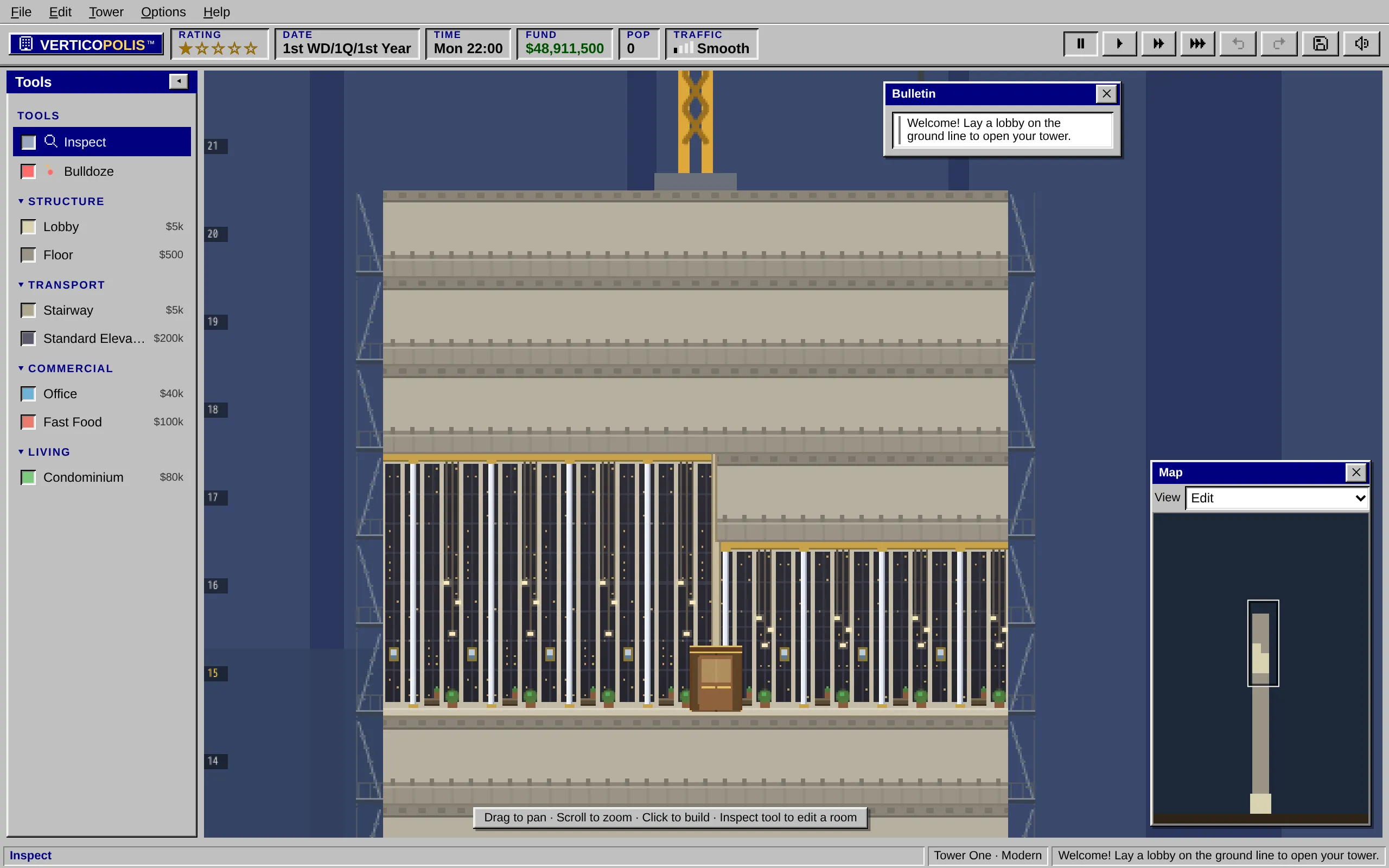
Section titled “Tall lobbies”A lobby can rise 2 or 3 stories as one open hall: one ceiling high overhead, wide arched windows and columns running floor to ceiling, chandeliers on long chains, and the benches and plants at their usual size on the floor.
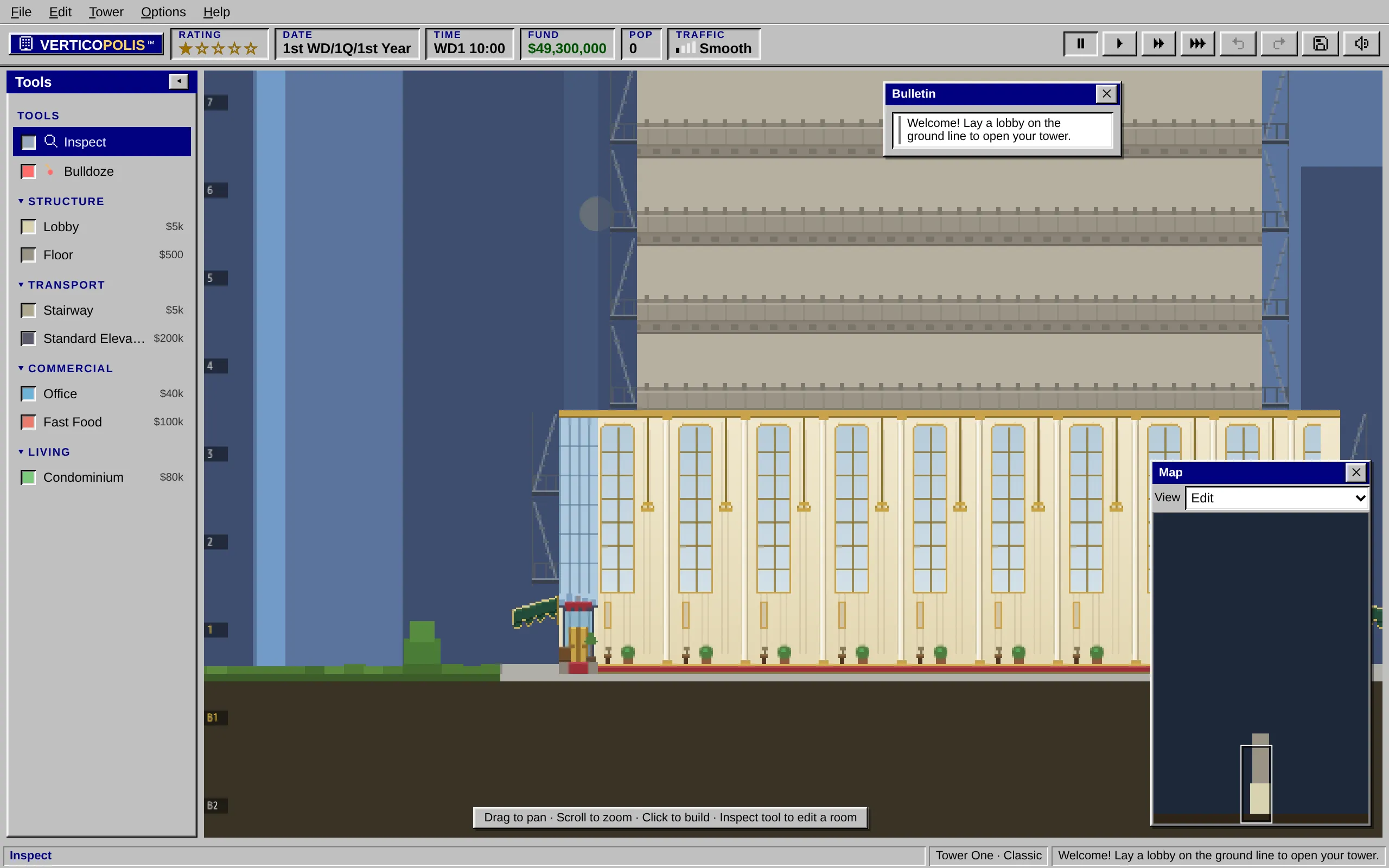
Building one
Section titled “Building one”- Pick Lobby from the build tools.
- Choose the height on the Lobby height strip that appears over the tower: 1 story, 2 stories or 3 stories. With a keyboard you can instead hold Ctrl (2 stories) or Ctrl+Shift (3 stories) as you place it.
- Lay the lobby as usual. The stories above it must be empty.

On a phone it works the same way: pick Lobby from the bar at the bottom, tap 2 stories or 3 stories on the strip, then tap the ground line to lay the lobby.
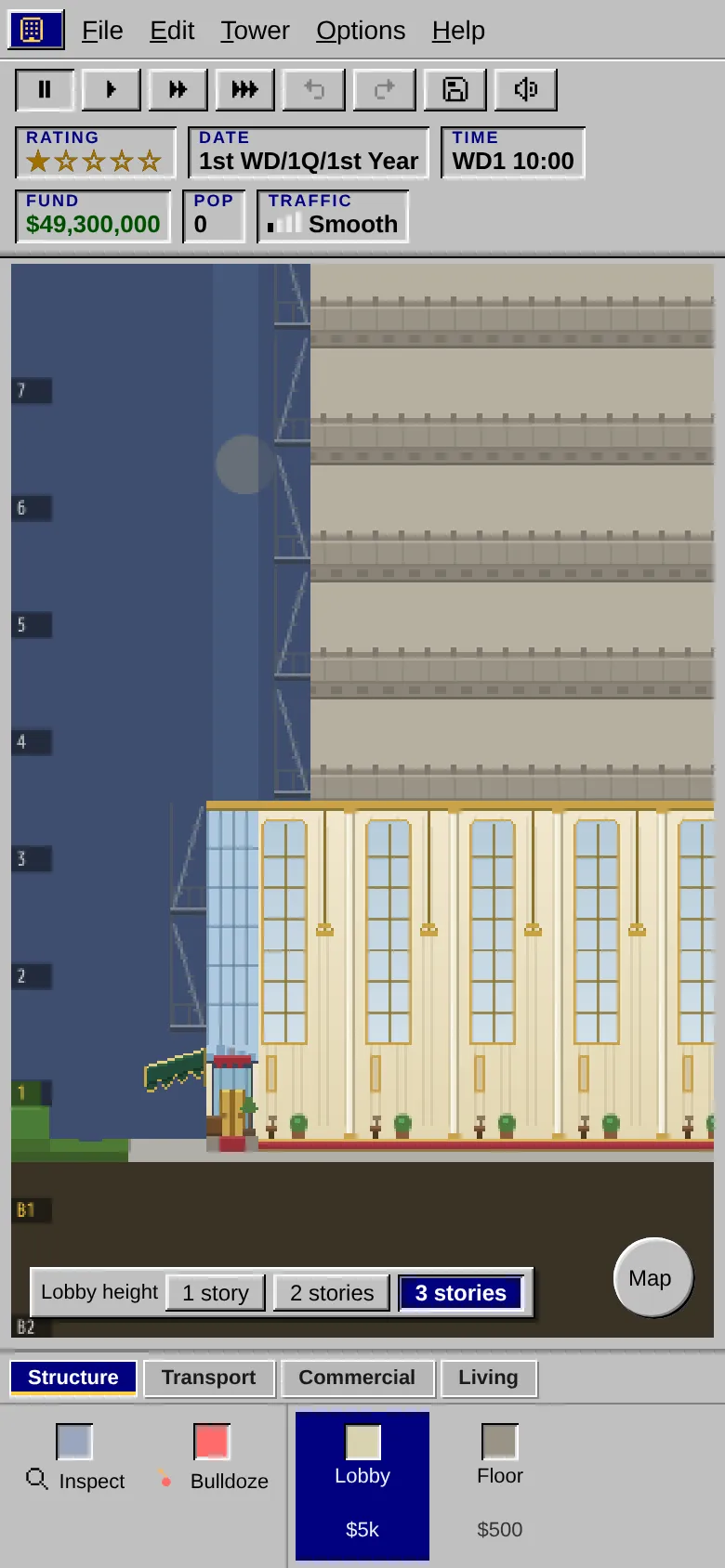
How they work
Section titled “How they work”- A lobby laid against another one takes its height, whatever the card says. Classic A floor’s first lobby sets the height for the whole floor, and it never changes after.
- Each story costs another lobby tile, so a 3-story lobby costs three times as much per tile.
- Nothing else can be built in the stories a lobby rises through. Elevators pass them without stopping. Stairs from the lobby wind up the whole hall as a spiral staircase, and an escalator zigzags up it with a landing at each turn. See Stairs and escalators.
- Distance to a tall lobby counts from its top story. The floor just above a 3-story hall is one floor from the lobby, so a shop or restaurant there earns in full, and homes and offices above it count their floors from the top of the hall.
Classic Only the ground lobby can rise. To build a sky lobby, pick 1 story first; the game refuses a taller one and says why. A Classic tower keeps its lobby height when you export it for the original game.
Modern Sky lobbies can rise too. A tall sky lobby is one hall behind a wall of glass, lit by pendant lamps. Built one by mistake? The bulldozer takes a sky lobby out a tile at a time; see Bulldoze and undo.
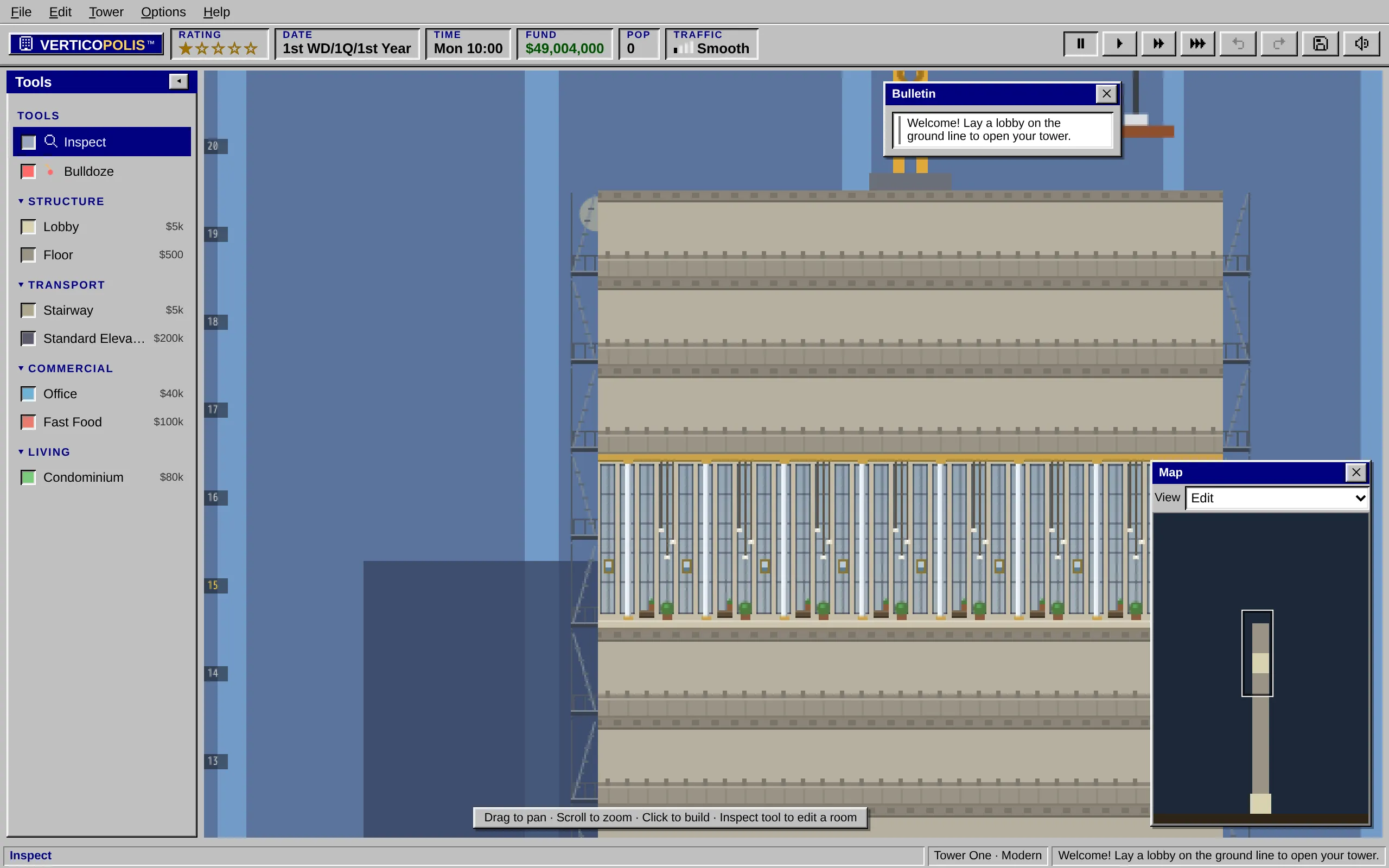
Halls side by side
Section titled “Halls side by side”Modern Each hall keeps its own height, so two towers can share a floor with lobbies of different heights.
- A new stretch of lobby takes the height on the Lobby card. A tile laid against a hall takes that hall’s height, and a tile that closes the gap between two halls joins the one on its left.
- Halls of the same height that touch become one hall.
- A hall claims only the stories over its own tiles. Next to a 3-story hall you can build floors over a 2-story one.
- An elevator skips a raised story only where its shaft passes through the tall hall.
Where two halls of different heights meet, a wall stands between them with an old wooden revolving door. The door turns only while someone walks through it, and two people can pass through it at once in opposite directions, each pushing a wing.
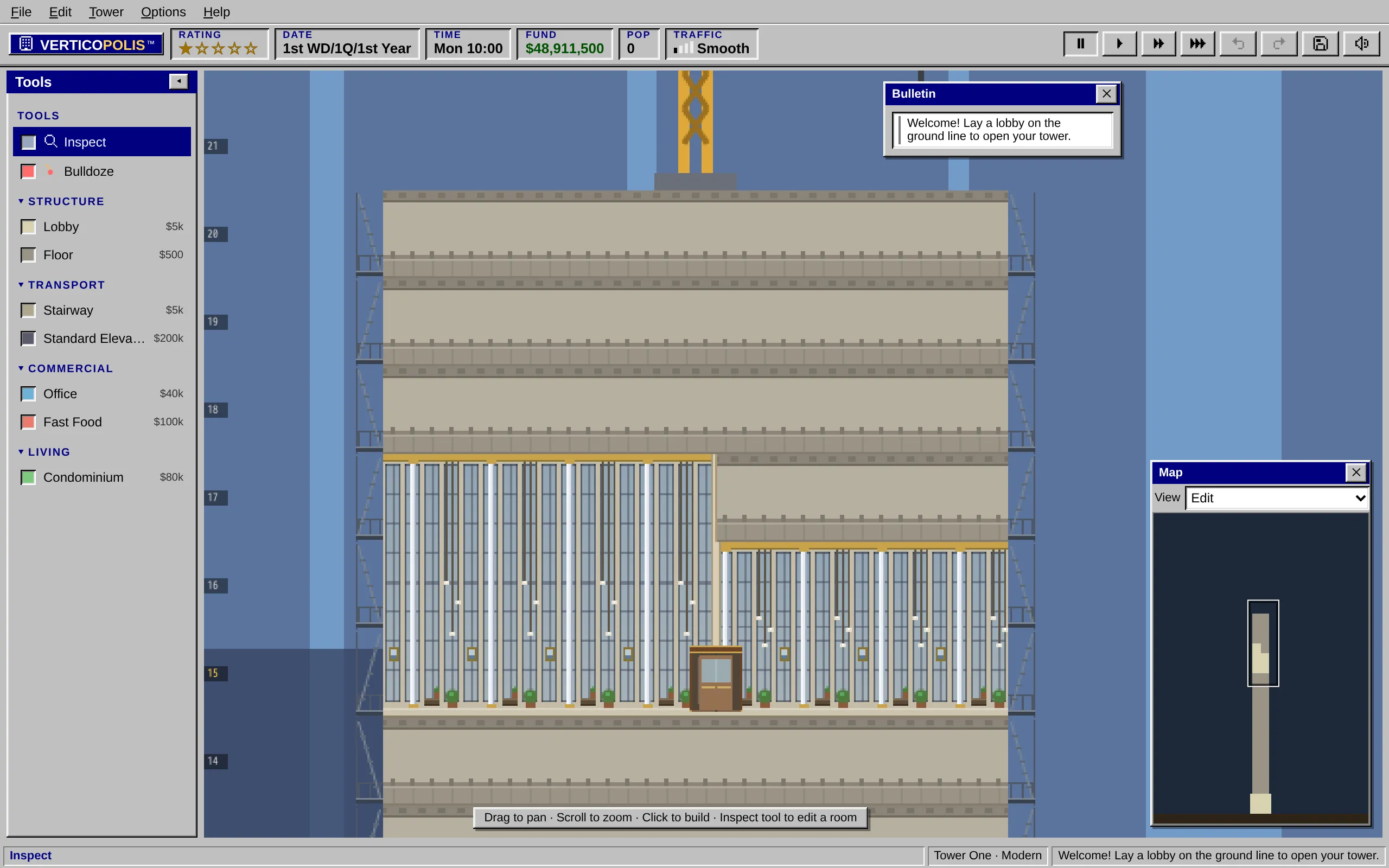
Sky bridges
Section titled “Sky bridges”Modern Two towers that stand side by side can share their sky lobbies. Lay lobby out across the open air between them on a sky lobby floor, and you have a sky bridge: one walkway from one tower’s sky lobby to the other’s. People cross it on foot, so someone in one tower can ride the other tower’s express when it has the shorter line.
- Build a sky lobby on the same floor in both towers.
- Pick Lobby and lay it out from the edge of either sky lobby, across the gap.
- Lay tiles until they meet the far sky lobby. Until the last tile goes in, the half-built bridge goes nowhere.
The rules:
- A bridge spans at most 24 tiles of open air, and there must be a sky lobby waiting on the far side. You can’t build one out into empty sky.
- Each bridge tile costs twice a lobby tile, floor included, since it is built out over the street.
- A bridge is one story high, even beside a tall lobby.
- A bridge carries nothing. No floor, room, elevator, stairs or escalator goes on it, above it or through it.
- Bulldoze any tile of a bridge and the whole bridge comes down, from one tower to the other, so it is never left in pieces. Each tower keeps its own sky lobby, and you get back half of what every tile cost. The bulldozer waits while anyone is walking across. The sky lobby tile a bridge hangs from stays until the bridge is gone.
- People on their way across a bridge that comes down find another way from where they stand. Nobody steps over the gap.
- A tower with a sky bridge uses Modern rules, so it can’t be exported for the original game.
Classic The 1994 game has no sky bridges. Every tile stands on the story below it.
Basements
Section titled “Basements”Some things only go underground: parking and the Metro Station. Homes (condos, studios and apartments), hotel rooms and offices never go below ground. Elevators and stairs reach the basements like any other floor.
A basement floor doesn’t have to sit under your tower. It only has to touch the basement floor beside it (or one above or below), so a garage can run the whole width of the lot under a narrow tower. Rooms go down to B9; B10 holds only the Metro Station’s tunnel, and once a station stands, nothing can be built below its bottom row.
Construction
Section titled “Construction”A new room takes a little while to build; you will see it under scaffolding, and it opens on its own when it’s done. Floors, lobbies and shafts are ready at once.
Classic As in 1994, you can’t start new construction while the game is paused. You build against the clock.
Modern You can pause, lay out a whole block, and let it go up when you start the clock again.